By Jane Metlikovec
What if AI, radical collaboration and complex chemistry hold the key to designing the world’s next dental filling – a filling that is strong, safe and long-lasting? That’s a question Rob Graham, a former English as a Second Language (ESL) teacher, and his fellow PhD colleagues, Jake Willett and Judy Chen, are aiming to answer.
The trio is part of the University of Melbourne’s first-of-its-kind industry PhD program, where dental products company SDI Ltd has partnered with the Melbourne Dental School and the Faculty of Engineering and IT (FEIT) to fast-track the development of next-generation dental materials.
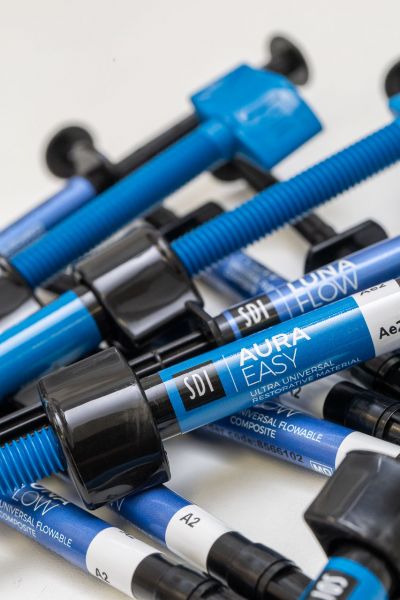
As the world turns away from traditional amalgam fillings due to toxicity concerns, industry focus has shifted towards developing resin-based composites – artificial resins reinforced with filler particles that are designed to match amalgam's durability without the perceived risks.
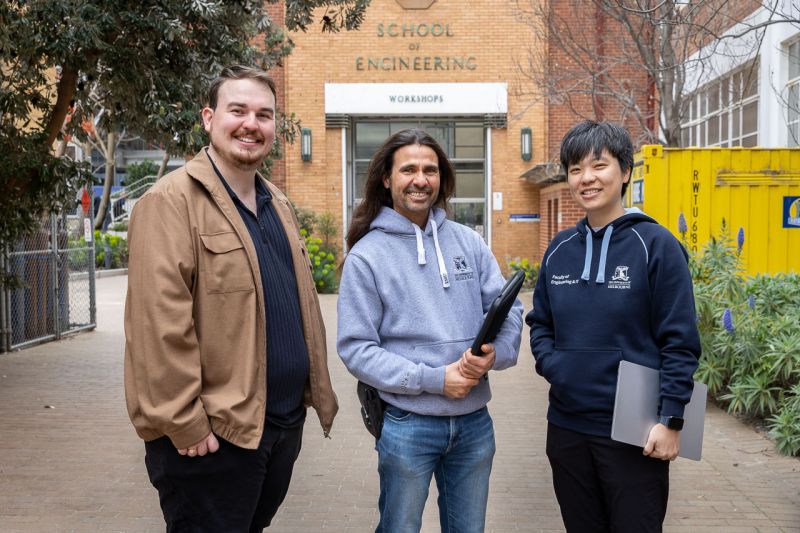
A chemist, a physicist and an engineer walk into a classroom…
In March 2025, physicist Jake Willett, chemist Judy Chen, and software engineer-turned ESL instructor-turned mechanical engineer, Rob Graham, met for the first time to begin their unique collaboration. Their goal was clear – to potentially discover a next-generation ‘super dental resin composite’.
Funded by the Australian Government’s National Industry PhD Program, industry partner SDI and a University of Melbourne stipend, they work as a team to more efficiently drive their innovative research project.
Credit: Peter Casamento.
Where chemistry, physics and AI click
Under the supervision of Dr Ellie Hajizadeh, Lead Investigator from the Department of Mechanical Engineering, and biomechanics expert Professor David Ackland from the Department of Biomedical Engineering, the group shares their skills and data to propel their project forward.
“We’re not having to spend time working on things outside our area of expertise and we collaborate continuously,” says Rob.
The idea is that you can tackle this problem from multiple perspectives, and have each inform one another. Jake Willet
“I could do simulations of new innovations at a small scale, which can inform what Judy might be doing at the mesoscale, and then that may inform what Rob’s doing at the macroscale. This feedback loop of helping each other from each of our perspectives of deep insight gets things moving fast.”
For Judy, her chemical experiments are where she most feels their combined power can solve complex problems.
"Usually, you perform one or two tests per day, and if you want to try something a little differently, that's for another day,” she says.
“For example, to keep moving forward and come up with 20 new formulations that you want to try, it could take you a month to test all of them. But with Rob’s modelling and AI skills and Jake’s work, we can improve this process and make it faster."
Academic curiosity meets industry focus
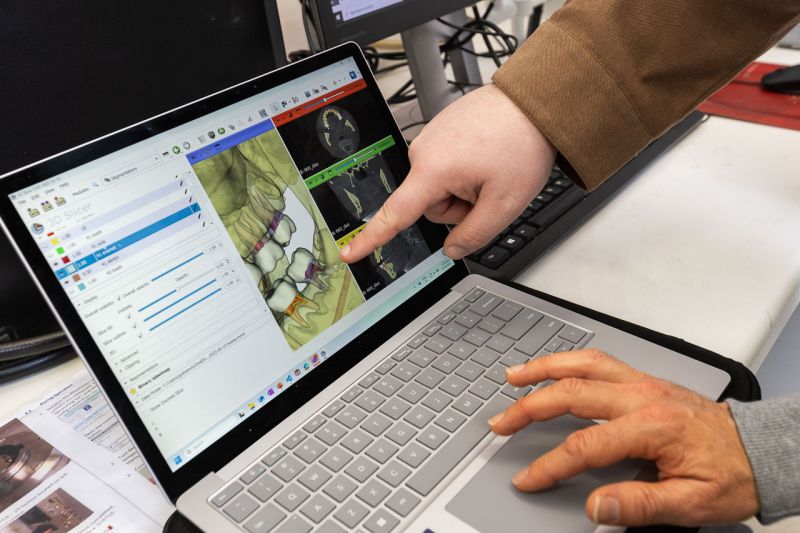
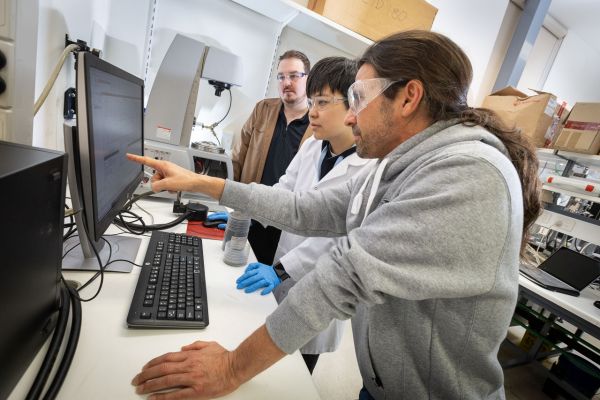
Rob’s background in software engineering, and his ability to work with AI to run and accelerate virtual tests, helps build team momentum. The progress at pace has interested industry partners like SDI, where the trio already works one day per week.
“Of course, industry is business-focused, as anyone would expect,” says Rob.
“But I've personally got a lot out of just listening to the industry partners and understanding first-hand how they go about developing technologies efficiently."
Gaining insights into how commercial research and development differs from academia has been useful for both parties, says Rob.
Industry doesn’t necessarily always lend itself to exploration and academia does a very good job of being able to do that with deep technical expertise. I think through this combined approach, there’s insight on both ends. Rob Graham
For now, the shared goal of a new composite resin breakthrough in the future remains.
“The idea of being able to design new materials for new purposes in this way really feels like the frontier of research,” says Jake.
“This interdisciplinary blend of physics, dentistry, engineering, and industry – combined with the uniqueness of an industry environment and a university environment – has been a dream come true.”
Enquire how to start your journey to commercialise your research