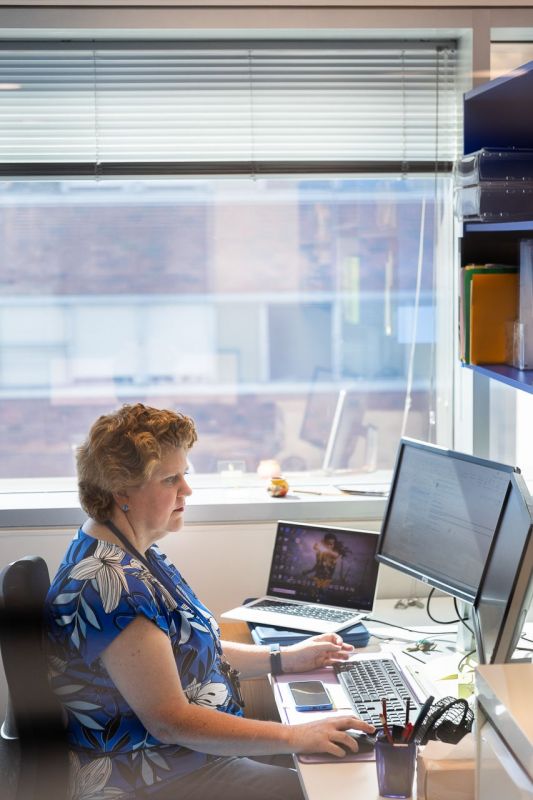
By Bianca Nogrady
The human mouth is home to an estimated six million bacteria from more than 700 species. Amid this teeming morass of bacterial diversity, one species has caught the attention of molecular microbiologist Associate Professor Catherine Butler, Principal Research Fellow at the Melbourne Dental School – Porphyromonas gingivalis.
Most people working in the dental field know this bacterium for its key role in gum disease, but Associate Professor Butler’s research suggests P. gingivalis plays a far more sinister role as a possible contributor to the development of Alzheimer’s disease.
Credit: Peter Casamento
Credit: Peter Casamento
A microbial detective
Associate Professor Butler was drawn to microbiology because of the possibility of playing detective by identifying what microbial agent was making a person sick and why. Her interest in P. gingivalis relates back to her PhD, when she was studying the iron needs of bacteria.
“All bacteria are limited by the amount of iron they can get in the body, so they all have mechanisms for competing with the host to secure iron for themselves,” she says. Blood is a rich source of iron, and P. gingivalis has found itself an iron-rich evolutionary niche in the inflamed gums of periodontitis.
Around six years ago, Associate Professor Butler came across a study which caught her attention. Another group of researchers had been inoculating mice with P. gingivalis and noticed that these mice were developing the neurological features of Alzheimer’s disease.
The most common form of dementia in Australia affects hundreds of thousands of people with memory loss, confusion, slower thinking and changes in behaviour. Two characteristic features of Alzheimer’s disease are abnormal clumps of a brain protein called beta amyloid, and twisted filaments in nerve cells of another protein called tau.
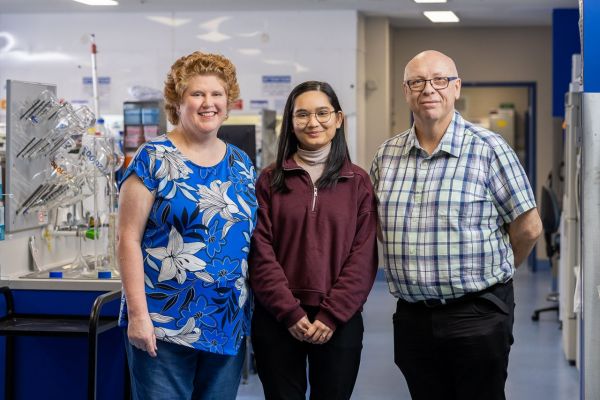
With nearly two decades of research on P. gingivalis behind her, Associate Professor Butler knew that she and her team – neuroscientist Dr Giuseppe Ciccotosto, immunologist Dr Bansari Shah, and long-term mentor and oral microbiologist Professor Stuart Dashper, all from the University of Melbourne – had the capability to study this fascinating phenomenon and its enormous potential for addressing a major chronic disease more closely.
Putting P. gingivalis in the spotlight
The first step was to repeat the experiments that first drew Associate Professor Butler to this question; inoculating mice with oral doses of P. gingivalis to see what effect it had on the brain. After 12 weeks of oral inoculation with the bacterium, the team found the same characteristic signature of Alzheimer’s disease in the brains of these mice.
However, one thing puzzled them.
“When we looked in the brains, we had lots of positive signal for the presence of the bacteria, using an antibody to detect a surface protein of P. gingivalis,” says Associate Professor Butler. But when they examined the mouse brains using an electron microscope, they found no evidence of any whole bacteria themselves.
Bacteria have a trick up their sleeve – the ability to generate smaller, simpler versions of themselves called vesicles. These nanostructures contain genetic material and molecules called virulence factors that help the bacteria to colonise, invade and cause harm to a host.
Scientists from the Melbourne Dental School have characterised the vesicles from P. gingivalis, and we know that they're enriched in virulence factors compared to the bacterium, so they're like little, tiny bombs. Associate Professor Catherine Butler
![A gloved finger points at a computer display of mouse cortical neurons growing in primary brain cell cultures.]](https://dental.unimelb.edu.au/__data/assets/image/0011/5414393/varieties/medium.jpg)
Credit: Peter Casamento.
The team wondered if it was actually the vesicles that were getting into the brain, rather than the whole P. gingivalis itself. So, they did more experiments where they prepared samples containing only purified P. gingivalis vesicles, then injected those into the mice.
“The first time point we examined was 24 hours later, and the bacterial vesicles were already present in the brain,” says Associate Professor Butler. While that experiment didn’t follow the mice long enough to be able to detect the pathological changes in the brain characteristic of Alzheimer’s disease, the researchers did see evidence of inflammation in the brain.
Recently, these results were presented at the International Association for Dental Research General Session meeting in Barcelona, Spain, and at the Alzheimer’s Association International Conference in Toronto, Canada. Studies by other scientists have also since shown that repeated injections of the P. gingivalis vesicles were associated with the appearance of plaques in mice brains, and even a decline in brain function.
Inflammatory link between gum disease and dementia
Associate Professor Butler speculates that P. gingivalis might have a unique set of virulence factors that are somehow interacting with proteins in the brain to contribute to Alzheimer’s disease-like pathologies. But with evidence growing that inflammation is a possible key culprit in a range of degenerative conditions – within the brain and beyond it – she suggests that any kind of periodontal pathogen causing inflammation could be contributing.
“My theory is that it's not just one bacterium. I think it is going to be a microbial aetiology, but I think it's going to be that several different microbes have longevity in the body which cause chronic disease and will be capable of contributing to Alzheimer’s disease,” says Associate Professor Butler.
Whatever the answer turns out to be, it is yet another reason to maintain good gum health and prevent periodontal disease.
Finding a cause – and therefore hopefully an effective treatment or prevention – for Alzheimer’s disease has been a long scientific quest marked by failure. But with funding from organisations including the Infectious Diseases Society of America Foundation and the National Health and Medical Research Council, Associate Professor Butler is excited to be bringing new ideas to this age-old challenge.
“I just love research - it's fascinating, you never have a dull day, you're always problem-solving, you're always thinking, you're never bored.”
Read more about research at the Melbourne Dental School