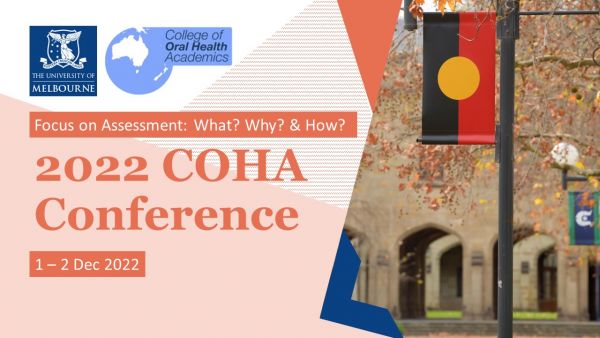
Welcome from the COHA Organising Committee
Greetings and welcome to Melbourne.
The University of Melbourne is very excited to be hosting COHA face-to-face this year, which hasn’t happened since 2019. We are looking forward to bringing oral health academics together from Australia, New Zealand and Fiji to discuss all things related to assessment and feedback.
This is a great opportunity to share your work, or the work of your students, with oral health academic colleagues.
We look forward to welcoming you to Melbourne.
Bree Jones and Roisin McGrath | Chairs 2022 COHA Organising Committee
The theme of COHA 2022
Focus on Assessment: What, Why, How?
The theme of the 2022 COHA conference is “Focus on Assessment: What, Why, How?”.
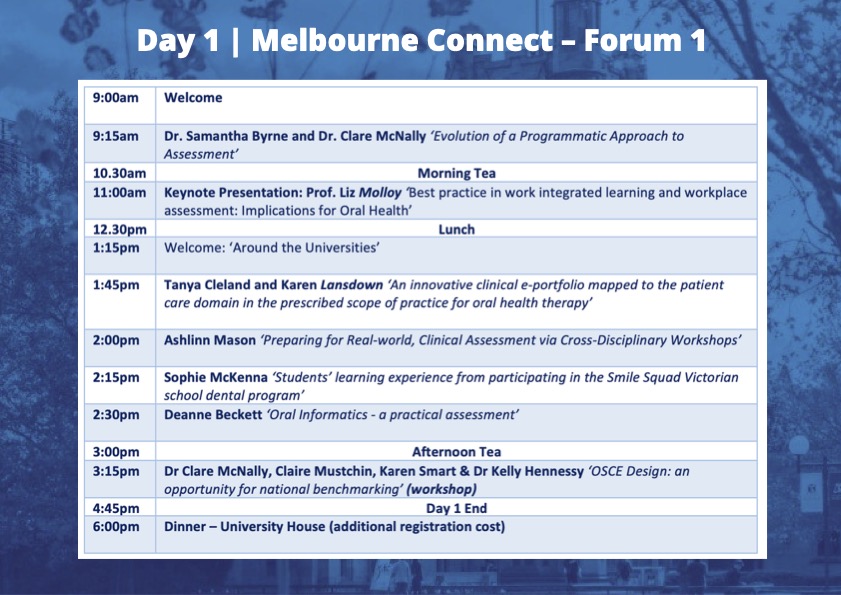
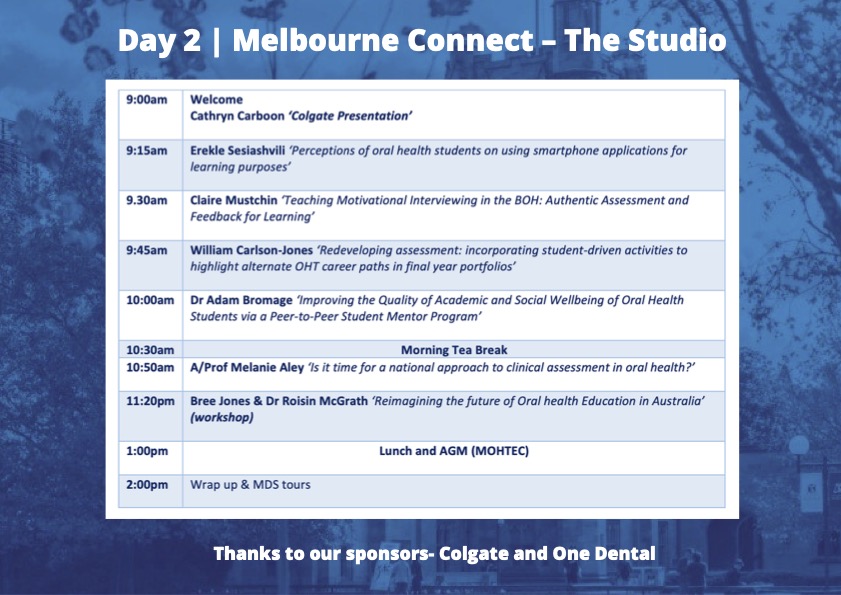
The two day event will include Oral Presentations, and Workshop, Networking events and the Annual COHA General Meeting. There will be two keynote presentations by Professor Liz Molly on ‘Assessment as Part of Work Integrated Learning’ and Dr Clare McNally and Dr Samantha Byrne on ‘Evolution of a Programmatic Approach to Assessment’.


Call For Abstracts | Deadline Extended 21st October
Call for Speakers- Deadlines for Abstracts Extended!!!
The organising committee are now calling for Abstracts and expressions of interest to conduct workshops and presentations for this conference.
Examples of Types
Assessment is a broad topic encompassing much of what we do as educators. It involves using feedback, evidence of students’ knowledge, understanding and skills to inform development of curriculum, activities, teaching, supports and evidence of progression. For examples of abstracts topics please click below
Submit your abstract for consideration now!
Registration Details
| Category | Price |
|---|---|
| 2 day registration | $100 |
| Optional 3 course dinner There will be an optional 3 course dinner hosted at University House on Thursday 1st of December, at an additional cost of $80 | $80 |
Information for Registrants
-
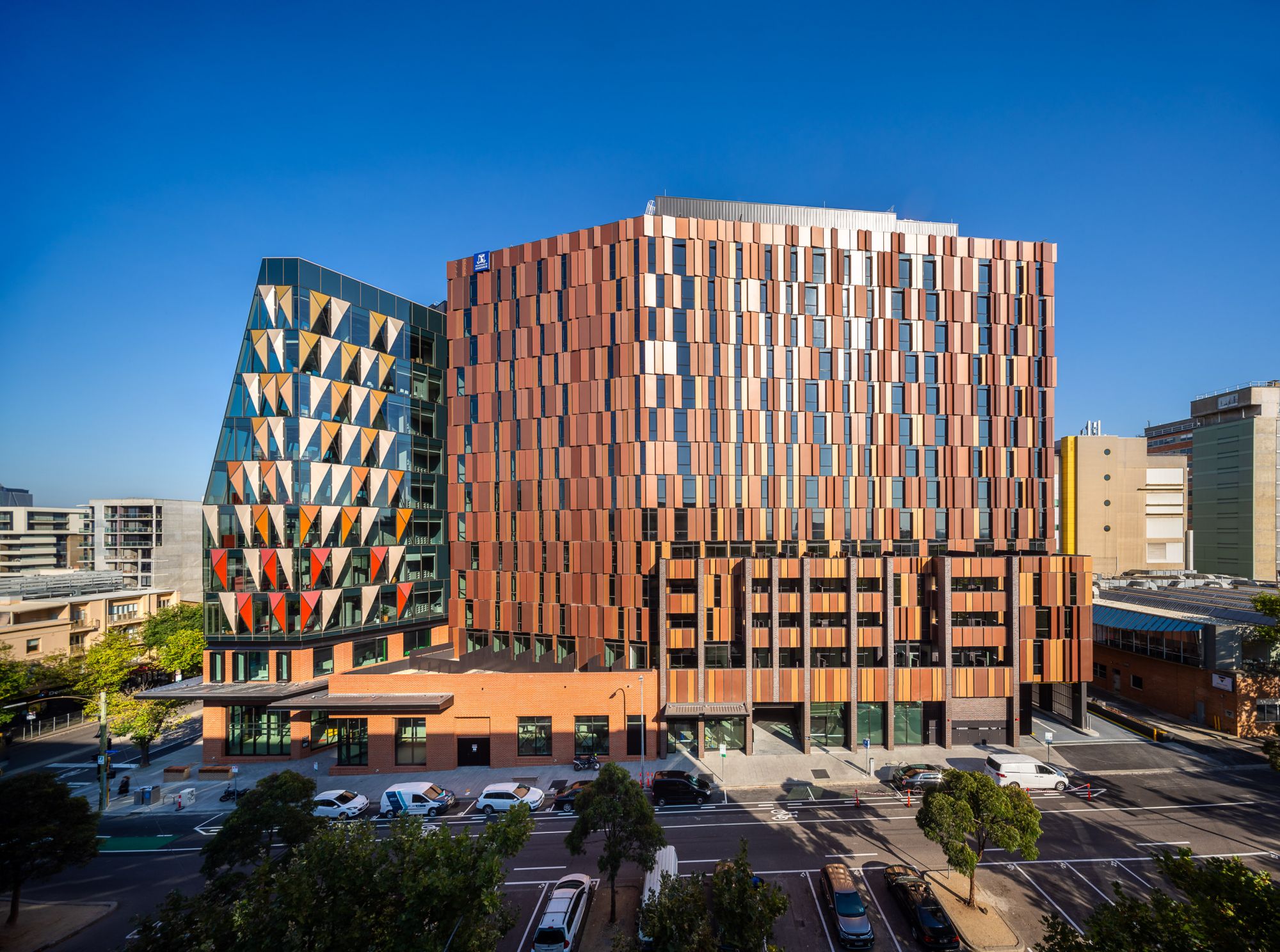
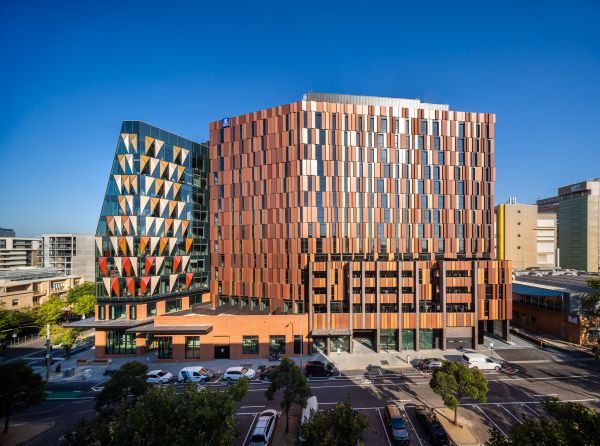
The venue for the 2022 College of Oral Health Academics (COHA) Conference is the Melbourne Connect, University of Melbourne, Melbourne, Australia. We have booked Forum 1 and 2, and the studio.
-
Hotel Room Rate 20/30 Single rm/ shared bathroom $85pn (b&d) Cnr Grattan & Drummond StSingle
Twin/Double
Triple
$170 (b)
$200 (b)
$255 (b)
15 Therry Street, Melbourne
From $119 / $139 (b)
From $139 / $159 (b) within 60 days
Jasper
Queen Vic MarketDeluxe king or Twin Room $149 room only
$25b (additional)
-
-
- Morning tea, lunch and afternoon tea will be provided to all registrations
- Please specify if you have additional dietary requirements in your registration.
Collaboration & Teamwork - Compassion - Respect - Integrity - Accountability
Collaboration & Teamwork - Compassion - Respect - Integrity - Accountability
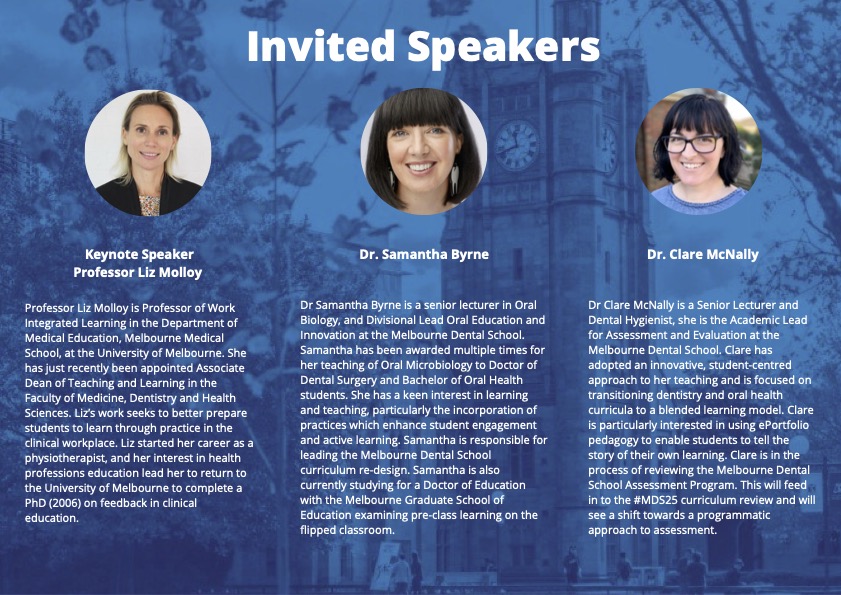
Keynote Speakers
Professor Liz Molloy
Professor Liz Molloy is Professor of Work Integrated Learning in the Department of Medical Education, Melbourne Medical School, at the University of Melbourne. She is Academic Director of Interprofessional Education and Practice in the Faculty of Medicine, Dentistry and Health Sciences. Liz’s work seeks to better prepare students to learn through practice in the clinical workplace. Liz started her career as a physiotherapist, and her interest in health professions education lead her to return to the University of Melbourne to complete a PhD (2006) on feedback in clinical education. Liz has published more than 115 peer reviewed journal articles, book chapters and books, with a focus on workplace learning, feedback and assessment, interprofessional education and clinical supervisor professional development. She received an inaugural Fellowship of the Australian and New Zealand Association for Medical Education (ANZAHPE) in 2015 and a Fellowship in Medical Education Research at the Karolinksa Institute (Sweden) in 2019. She is Associate Editor of the journal Focus on Health Professions Education and Chair of the ANZAHPE Conference in 2020.


Dr Clare McNally
Dr Clare McNally is a Senior Lecturer and Dental Hygienist, she is the Academic Lead for Assessment and Evaluation at the Melbourne Dental School. She is also responsible for teaching periodontics and dental hygiene in the Bachelor of Oral Health (BOH) at the Melbourne Dental School. Clare's PhD (Medicine) at the University of Adelaide was looking at the relationship between oral health and systemic health in hospitalised older people. Since starting at Melbourne in January 2018, Clare has been responsible for reforming the periodontics and dental hygiene curriculum within the BOH. During this time Clare has adopted an innovative, student-centred approach to her teaching and is focused on transitioning dentistry and oral health curricula to a blended learning model. Clare is particularly interested in using ePortfolio pedagogy to enable students to tell the story of their own learning. Clare is in the process of reviewing the Melbourne Dental School Assessment Program. This will feed in to the #MDS25 curriculum review and will see a shift towards a programmatic approach to assessment. There will be opportunities to study Research Higher Degrees with Clare and the teaching and learning team as these reviews progress. Look forward to you getting in touch.

Dr Samantha Byrne
Dr Samantha Byrne is a senior lecturer in Oral Biology, and Divisional Lead Oral Education and Innovation at the Melbourne Dental School. Samantha has been awarded multiple times for her teaching of Oral Microbiology to Doctor of Dental Surgery and Bachelor of Oral Health students. She has a keen interest in learning and teaching, particularly the incorporation of practices which enhance student engagement and active learning. Samantha completed her PhD in 2006 where she explored the microbial composition of dental plaque associated with periodontal disease progression. This work was recognised by the Australian and New Zealand division of the International Association of Dental Research with the Oral Biology Award in 2010. She maintains a research interest in the microbial aetiology of chronic periodontitis and dental caries and supervises Doctor of Clinical Dentistry and Bachelor of Science Honours students. Her current research interests also include the use of social media as a platform for the dissemination of oral health information. Samantha is also currently studying for a Doctor of Education with the Melbourne Graduate School of Education examining pre-class learning on the flipped classroom.
Collaboration & Teamwork - Compassion - Respect - Integrity - Accountability
Examples of Types of topics/abstract topics
Assessment is a broad topic encompassing much of what we do as educators. It involves using feedback, evidence of students’ knowledge, understanding and skills to inform development of curriculum, activities, teaching, supports and evidence of progression.
It could include any of the following:
- peer feedback opportunities amongst students, mentoring, ongoing feedback in response to clinical assessment/pre-clinical assessment,
- how we prepare students for assessment, what activities we do to engage students with content to prepare for assessment/clinical practice, assessment design, rubric design, examples of what didn’t work well, what did, how we had tried to address problems, course feedback,
- how we use reflection and feedback to shape and develop our teaching- materials and programs, evaluation surveys, SES data, what assessments people are doing in other programs- (what work, what don’t),
- how can we collaborate to address some of these challenges, benchmarking, have we kept any changes that were implemented during covid, innovations in simulation and student experiences with this, OSCEs, portfolios, clinical assessments,
- how do we give feedback? How do we handle assessment when students are on clinical placement to ensure goals of course are being met, how do we store the feedback data we collect and what do we do with it? Are we evaluating are teaching? How are we evaluating it?
Almost all of our teaching and learning activities would fit well into any of these categories!
There will be awards and prizes for Oral and Poster presentations! We are excited to hear what the Universities are doing in this space- and encourage everyone to submit an abstract.
There are 3 categories:
- Workshops (90 Minutes)
This category is for interactive sessions with participants that focus on developing skills in a particular area of assessment. Please submit an EOI by following the Guidelines for submission of an EOI for workshops attached.
- Oral Presentations
For this category, abstracts topics must be in accordance with the COHA program ‘Focus on Assessment, what, why and how?’ Please see abstract format and layout guidelines attached.
5 minute rapid fire presentation:
- This format is similar to a three-minute thesis (3MT) style of presentation, that builds on a classic “elevator pitch”. This presentation follows different rules to traditional scientific presentations, and should be focused around communicating several key messages. The challenge in this type of presentation is to explain your research clearly and concisely to an intelligent non-specialist audience in under 3 minutes. You can only have 1-3 slides for this type of presentation.
15-30 minutes presentation:
- This format follows a more traditional style of scientific presentation. On notification of outcome, applicants will be advised if they have a 15 minute or 30 minute length.
- Poster Presentations
- For this category abstracts can be research that does not fit with the conference theme. The purpose of the posters is to showcase the breadth of activities amongst COHA members. You may want to present a poster created by students you have supervised to showcase student work. Please see abstract format and layout guidelines below.
Instructions for Submission of Abstracts and EOI Submission
- Abstracts must be submitted by a COHA member.
- Read the submission guidelines for your chosen category below carefully.
- Submit your abstract by clicking on this link- COHA 2022 Abstract and EOI Submission Form or click on the QR code
- Abstract Submission will close on the 21st of October 5pm.
- Notifications of outcomes will be distributed via email by on the 28th of October.
For any questions regarding the above process, please contact Bree Jones
Presentation Guidelines
1. Workshops EOI Guidelines
Workshop Title
The workshop title should be within a maximum of 120 characters. The title should be informative and contain the major key words.
Presenters
The format for authors (including co-authors) is first name, then surname. The presenting author should be listed first and underlined. Affiliations of authors should be included using superscript numbers. Author's institution should be specified indicating the name of the institution, followed by city, state, and country. Do not include degrees or professional titles (E.g. Dr., Prof., etc.)
Body
This section must include the overall purpose/aims of the workshop with justification for how it relates to the conference theme. Please provide 3 objectives and an overview of proposed workshop activity/ies.
2. Oral Presentation & Poster Guidelines
Title
The abstract title should be within a maximum of 120 characters. The title should be informative and contain the major key words.
Presenters
The format for authors (including co-authors) is first name, then surname. The presenting author should be listed first and underlined. Affiliations of authors should be included using superscript numbers. Author's institution should be specified indicating the name of the institution, followed by city, state, and country. Do not include degrees or professional titles (E.g. Dr., Prof., etc.)
Body
The body of the abstract should be no more than 250 words. This should be a summary of the research to be presented. Abstracts must include background, methods, results/outcomes and conclusion. Abstracts may include original research and results, protocols, quality improvement project, innovation, project design & implementation, case/reports.
COVIDSafe plans
-
The University continues to follow Victorian public health orders for face masks. You must carry a face mask at all times and wear one as required under current COVIDSafe Settings.
The Victorian Department of Health strongly recommends wearing a mask indoors and whenever you cannot physically distance. The University encourages everyone to follow this advice to help reduce the transmission of airborne viruses (all existing exemptions continue to apply).
Face masks will no longer be expected in classroom settings, however they continue to be strongly recommended indoors and whenever people cannot physically distance.
-
The University has implemented enhanced infection control and cleaning measures across all facilities, including:
- More frequent cleaning and disinfection by professional cleaning staff
- Self-service infection control measures, such as 2500+ touch-free hand sanitiser dispensers and 3000+ alcohol wipe dispensers
- Additional deep cleaning, disinfection and site closures as needed in response to a confirmed case of COVID-19
-
- People are encouraged wherever possible to maintain a physical distance of 1.5m between themselves and others
- Indoor spaces have been reconfigured and plexiglass barriers installed in some service areas to facilitate physical distancing
- Signage and floor decals provide reminders for people to maintain physical distance of 1.5m where possible
- Wearing a face mask is strongly recommended whenever you cannot maintain a physical distance of 1.5m between yourself and others
-
The University has reviewed buildings for adequacy of ventilation capacity and introduced a variety of measures to reduce the risk of indoor transmission of COVID-19, including:
- Increasing ventilation by mechanical or natural means where necessary
- Where the system is unable to ensure to adequate air intake and exchange, other mitigations, such as portable air purifiers have been deployed
- Real-time monitoring of carbon dioxide (CO2) levels as a proxy to evaluate airborne virus risk and adequate fresh air supply – monitors have been installed in teaching spaces and some other spaces to actively monitor air quality
- Encouraging greater use of outdoor spaces
Find out more about ventilation.
Refund, Cancellation and Substitution Policy
-
All registrations are subject to the cancellation policy. Cancellations must be made in writing by the deadline date; telephone cancellations will NOT be accepted. Refunds or credits will not be given for failure to attend events. Refunds will be processed no later than 8 weeks after the meeting.
DEADLINE DATE:
On or before November 4th 2022: Refund less $50 AUD cancellation fee.
All refund requests and requests must be completed by emailing mds-researchsupport@unimelb.edu.au with header COHA 2022 REFUND REQUEST
-
Refunds will be processed no later than 8 weeks after the meeting.
We welcome the use of social media to promote COHA 2022 and communicate its findings. Please use the hashtag #coha22 in social media posts related to the conference. Session chairs and presenters will confirm whether live tweeting or other social media communication of the content of their sessions or presentations is allowed.